
The next revolution in artificial intelligence has arrived. As of August 7, 2025, OpenAI’s most powerful and efficient model, GPT-5, is now available via API and integrated directly into ChatGPT. This is not just an incremental update; it’s a foundational shift in AI capability. As CEO Sam Altman puts it, if GPT-4 felt like a college student, interacting with GPT-5 is like having a “legitimate PhD-level expert in anything, any area you need, on demand.” GPT-5 is engineered from the ground up to excel in complex coding, execute sophisticated agentic workflows, and master long-context reasoning, all while delivering unprecedented real-world usability and precision.
What’s New in GPT-5? A Generational Leap in Performance
GPT-5 sets a new standard for intelligence and efficiency, dominating the most challenging industry benchmarks while introducing a more robust safety framework.
Benchmark Dominance: Not Just Smarter, but More Efficient
The model’s performance isn’t just about higher scores it’s about achieving them with greater resourcefulness.
Unrivaled Coding Prowess:
- SWE-bench Verified (Coding): On this difficult benchmark for real-world software engineering tasks, GPT-5 achieves a score of 74.9%, significantly outperforming the previous top model’s 69.1%. Even more impressively, it does so using 22% fewer output tokens and 45% fewer tool calls, making it both smarter and leaner.
- Aider Polyglot: In multi-language coding tests, GPT-5 scores a remarkable 88% using chain-of-thought reasoning, establishing a new state-of-the-art and leaving previous GPT-4 variants behind.
Expert-Level Reasoning in Science and Math:
- Math: GPT-5 Pro with Python tools achieves a perfect 100% accuracy on the Harvard-MIT Mathematics Tournament (HMMT) benchmark.
- Science: On the GPQA Diamond benchmark for PhD-level science questions, GPT-5 Pro with Python scores 89.4%, far surpassing GPT-4o’s 70.1%.
- Health: GPT-5 has a dramatically lower hallucination rate on health-related queries, with an error rate of just 1.6% on hard medical cases, compared to 15.8% for GPT-4o.
An Agentic and Tooling Powerhouse
Where GPT-5 truly shines is in its ability to act as an intelligent agent. It can understand complex goals, break them down into steps, and use tools with surgical precision. On the τ²-bench telecom benchmark, which tests the ability to handle complex sequences of tool calls, GPT-5 scores a near-perfect 96.7%, proving its reliability for even the most demanding automated workflows.
What This Means For Everyone: A Smarter, More Personal ChatGPT
Beyond the benchmarks, GPT-5 brings a suite of new features that make the ChatGPT experience more personal and powerful.
- Enhanced Voice and Learning: The voice model is more natural than ever and is available to all users for extended conversations. A new “Study and Learn” mode guides you step-by-step through any subject.
- Personalities & Customization: You can now change ChatGPT’s interaction style with personalities like Cynic, Robot, or Listener. Paid users can also customize the app’s accent colors.
- Memory Integrated with Your Life: Starting with Pro and Plus users, the Memory feature can now securely connect to your Google Calendar and Gmail. This allows ChatGPT to help you plan your day, find unanswered emails, and prepare for trips based on your personal information.
Built for Developers: Unprecedented Power and Control
GPT-5 represents a paradigm shift for developers, moving beyond simple code completion to true “software on demand.” It’s the best model for agentic coding tasks, front-end development, and complex instruction following. Here’s what’s new in the API.
- Three Tailored API Models: Developers can now choose the perfect model for their needs:
- gpt-5: The full-capability flagship model for maximum performance.
- gpt-5-mini: A cost-effective model balanced for performance and economy.
- gpt-5-nano: An ultra-low latency model designed for on-device and real-time applications.
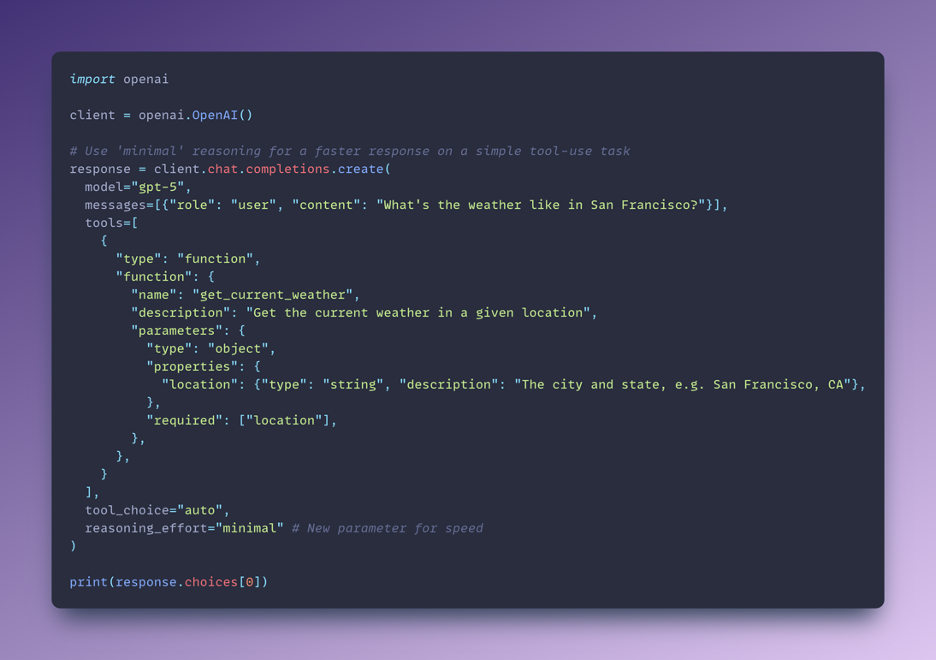
- Customizable Reasoning and Output: For the first time, developers can fine-tune the model’s behavior with new API parameters. Control reasoning_effort (minimal, low, medium, high) to adjust how deeply the model thinks and verbosity (low, medium, high) to manage the detail level of its output.
- Massively Expanded Context Limits: GPT-5 shatters previous limitations by accepting up to 272,000 input tokens and outputting up to 128,000 tokens. With a total context capacity of 400,000 tokens, it can process entire codebases, extensive documentation, or complex research papers in a single pass.
- New API Controls & Code Examples: For the first time, you have fine-grained control over the model’s behavior.
- Control over Verbosity and Reasoning: Use the verbosity parameter to control response length and reasoning_effort to manage the trade-off between speed and depth.\
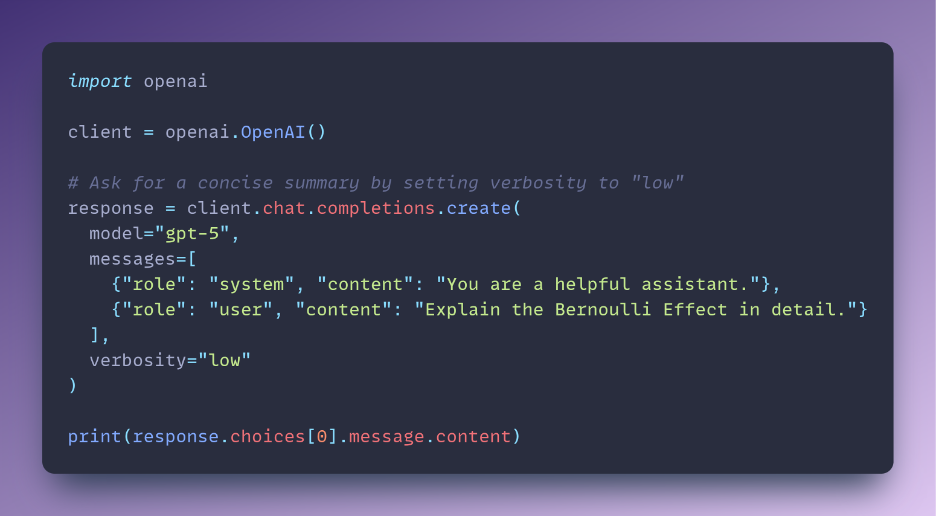
- Simplified and More Robust Tool Use: A new custom tools type allows calling tools with simple plaintext instead of JSON. Additionally, new tool call preambles let the model explain its plan before executing a tool, and this behavior is fully controllable.
- Example 2: Tool Call with Minimal Reasoning for Speed
Real-World Impact: From Your Code Editor to the Cloud
GPT-5 isn’t just a research model; it’s already being deployed across the industry’s most critical tools. It is now integrated into GitHub Copilot (in public preview), Microsoft Copilot, and the Azure AI Foundry, bringing its next-generation capabilities to millions of users.
Major enterprises are already confirming its standout performance:
- Cursor calls GPT-5 “the smartest model we’ve used,” praising its intelligence, steerability, and even its capacity for personality.
- Vercel highlights its leadership in front-end generation, noting that its aesthetic and code quality were preferred 70% of the time over all other models.
Conclusion
GPT-5 redefines what an AI assistant can do it’s faster, smarter, and profoundly more efficient across coding, reasoning, and agentic tasks. With deep customization, an enormous context window, and seamless multimodal integration, it is built to scale from individual hobbyists to the most demanding enterprise-grade applications. It represents a new paradigm of human-computer collaboration.
FAQs
- How is GPT-5 different from GPT-4o for a regular ChatGPT user?
- What are the main differences between the gpt-5, gpt-5-mini, and gpt-5-nano API models for developers?
- How has safety and reliability been improved in GPT-5?
- What new API controls do developers have with GPT-5?
- If you want to know more? See this video
Answers:
- For a regular user, GPT-5 offers a major leap in both intelligence and personalization. The experience feels less like talking to an AI and more like collaborating with a “PhD-level expert.” Key differences include:
- Higher Accuracy & Reliability: It has a dramatically lower hallucination rate, making it more trustworthy and factual.
- Smarter Reasoning: It automatically thinks more deeply about complex questions to provide more insightful and comprehensive answers.
- Enhanced Voice Mode: The voice assistant is more natural and includes a new “Study and Learn” mode to guide you through topics.
- Greater Personalization: You can now customize the AI’s interaction style with Personalities (like Cynic or Robot) and even change the app’s color scheme.
- Deeper Memory: The model can now integrate with your Google Calendar and Gmail, allowing it to help plan your schedule and manage communications based on your personal information.
- The three API models are tailored to give developers the flexibility to choose the right balance of power, cost, and speed for their applications:
- gpt-5: This is the flagship model, offering maximum performance and capability for the most demanding tasks. It is priced at $1.25 per 1 million input tokens.
- gpt-5-mini: This is the balanced, cost-effective option. It is designed for general-purpose tasks and still outperforms previous generation models like GPT-4o.
- gpt-5-nano: This model is optimized for speed and affordability. It offers ultra-low latency for real-time applications and is 25 times more affordable than the flagship gpt-5 model.
- Safety and reliability were core priorities. The improvements are twofold:
- Reliability: The model has a significantly lower rate of “hallucination” (making things up), making it OpenAI’s “most factual model ever.” This increased accuracy makes it more dependable for critical tasks.
- GPT-5 gives developers significantly more fine-grained control over the model’s behavior through several new API parameters and features:
- verbosity: Allows you to control the length and detail of the model’s response by setting it to low, medium, or high.
- reasoning_effort: Lets you manage the trade-off between response speed and analytical depth. For example, setting it to minimal will return answers faster for simpler queries.
- custom tools: Simplifies tool integration by allowing developers to define tools using simple plaintext instead of requiring JSON formatting.
- tool call preambles: A feature that allows the model to output an explanation of its plan before it executes a tool, giving users more transparency and control over agentic workflows.